


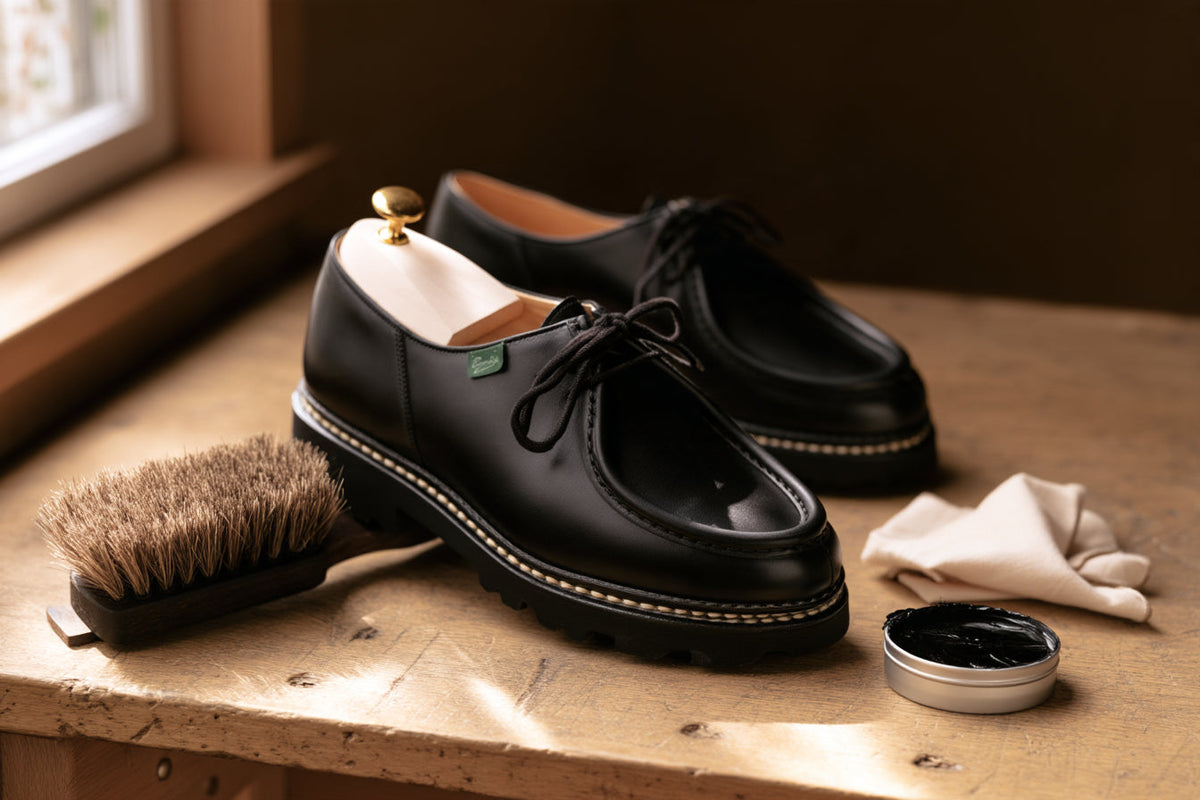
Caring for your shoes
Palmer Notes · Joshua, 27 November 2026

Most good shoes are not worn out; they are dried out, on a radiator, the morning after a wet walk. Nearly everything else in shoe care is minor by comparison.
Give them a day off
Leather takes in moisture from a day's wear, and it needs a day, at least, to give it back. Two pairs worn in turn will outlast two pairs worn one after the other, by some distance.
Trees, straight away
Put shoe trees in as soon as they come off. Unvarnished cedar, ideally: it draws out the damp while the leather is still warm, holds the shape, and keeps the creases across the vamp shallow rather than deep.
Brush after wearing
A horsehair brush, a minute's work. On a Norwegian-welted shoe like the Paraboot Michael this matters more than it sounds: grit settles in the stitching round the sole, and left there it wears at the thread.
Cream, then wax
Feed the leather every few weeks with a cream polish in the shoe's colour, or a neutral one if you are unsure. Let it sit, then buff. Wax is for shine, and belongs on the toe and the heel only – put it where the shoe flexes and it cracks.
When they get wet
Stuff them with newspaper or put the trees in, and let them dry at room temperature, slowly. Never by a radiator or a fire. Heat is what turns a soaked shoe into a cracked one – or I should say, it is what turns a recoverable shoe into an unrecoverable one.
Suede
Suede asks for less. A suede brush to lift the nap, a protective spray before the first wear, and no cream at all.
Soles
Soles last a long time on a Paraboot, but not forever. A welted shoe can be resoled by a good cobbler, so take them in before you wear through to the welt, not after.
If you are not sure what your pair needs, bring them into 9a Clayton Road and ask.